Monday, December 17, 2012

Judging swell height while at sea

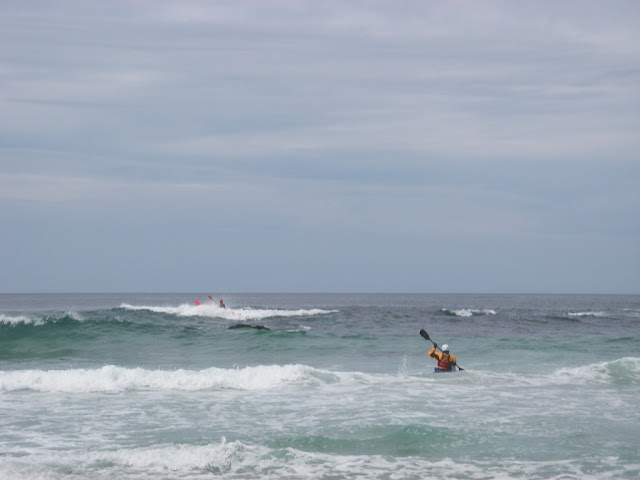
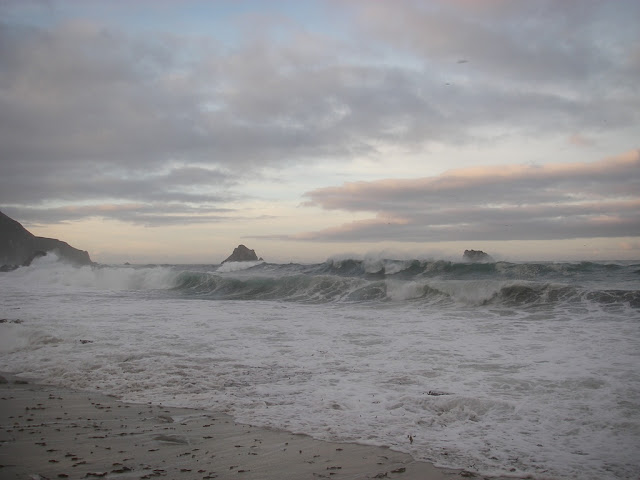
While I was on a recent paddle down the coast several folks were wondering as to the height of the swell. The prediction for the day was 4-5ft at 10 seconds, or there about. Of course everyone attempts to estimate swell and wind wave size while they're out there. Usually, not always but usually, people are wildly off in their estimates.

When I was doing a BCU 3* assessment a couple years ago we were at the further edge of conditions that we could have been assessed in and the coaches asked everyone how big the waves we had just been in were. 2 to 3 foot was the common response. It was actually like 1 to 1.5 feet. On the trip down the coast some folks were throwing out numbers like 8 feet, as big as a house, and stuff like that. There was talk about the swell being influenced by the bottom and so jacking up a bit.

Anyway, despite the fact that there are approximately 1.83 million web pages that talk about wave dynamics, I figured I'd take a few minutes and come at the subject from the perspective of a sea paddler. Fair warning, there is some math ahead.

There's a book called Waves and Beaches by Willard Bascom. Even though it's quite old (mine is from 1964) there is a huge amount of profoundly useful information in it. One subject it discusses is when a wave is influenced by the bottom. Waves that are influenced by the bottom are called shallow water waves. Shallow water waves are defined those that moving through water that has a depth of:

\begin{equation}.5 L\end{equation}

where L is the wavelength of the wave. The wavelength of the wave can be approximated by

\begin{equation}\frac{g}{2\pi}T^2 = 5.12\times T^2\end{equation}

where T is the period of the wave. Note please this formula is for a perfect sine wave. There are far more accurate formulas that take into account the height of the wave and so forth. But I think for this discussion the approximation is sufficiently accurate.
I didn't actually measure it while I was out there, but the prediction was for a period of 10 seconds. If we plug that in to the equation above we get

\begin{equation}5.12\times10^2=5.12\times100=512\end{equation}

From the definition of a shallow wave water above we get

\begin{equation}.5\times512=256\end{equation}

So if we were in less than 256 feet of water then the wave would be influenced by the bottom and, in fact, we were in far less than 256 feet of water. Absent this fact then we would have a deep water wave which could not have real cause, generally, to deviate far from the predicted values. Which get's us to the real heart of the matter.

We now have to calculate what I'll call the jack up factor. The jack up factor is basically the factor one can apply to the predicted swell height so as to arrive at the swell height at a specific location. There are actually 2 components to the jack up factor. The first is the HS component.

The HS component ranges from 0 to 2 with a nominal value of 1. The value for the HS factor is proportional to the degree of surprise one felt when the swell jacked up. Typically, though not always, the value of HS is directly proportional to the volume of the exclamation "holy shit" that frequently accompanies someone turning around and seeing an unexpectedly large wave behind them. Note that it is not the wording of the exclamation (e.g. "oh boy", "oh no", "lookit that" are all acceptable) but the volume that is significant here. One thing that can influence the value of HS is the audience to which the swell height estimate is being presented. For example an audience of well experienced paddlers that one wishes to impress might cause one to reasonably reduce the value of HS substantially.

The next component of the jack up factor is the BS component. The BS component ranges has a range from 1-5 with a nominal value of 5. The specific value of the BS component is influenced by many things. The naïveté of the audience of the estimate has a large influence on the value as can, for male estimators, the maximum attractiveness of the set of females present in the audience of the estimate. It is also the case that the BS component value is inversely proportional to the estimators self esteem.

Given all of this we can see then that given the prediction of 4-5 feet at 10 seconds in the depth of water we were in fact in (47 feet or so) there is basis for a reasonable estimate of swell height outside of the rather boring prediction of expert agencies and their frequently mis-calibrated buoys. Specifically we can say that the swell ranged from

\begin{equation}[4\times HS\times BS, 5\times HS\times BS]
=
[4\times 0 \times 1, 5\times 2 \times 5]
=
[0, 50]
\end{equation}

That is, the swell was from 0 to 50 feet that day at a specific place along the route taken.

Swell estimation, as I think has been made clear, is not easy. One cannot rely on data from buoys that were located, in many cases, miles away from where one actually experienced the swells to be estimated. Rather it is the application of scientific formulas, as above, that provides the basis for understanding and, far more importantly, the describing of the conditions one paddles in.

I hope this brief treatment of such a complex subject proves useful for both those who estimate swell height and for those who must consider the accuracy of swell height descriptions one may be subject to at the bar following a paddle.

Tuesday, December 11, 2012

Our harsh winter environs

Living in central California has some pretty serious drawbacks. It's incredibly crowded for one. Housing is ridiculously expensive. Road rage is something you at least come to understand if not fight against. One thing that helps make up for some of that is the weather. This past weekend I joined a few fellow club members and braved the elements in an attempt to paddle from Moss Landing down to the beach behind Monterey Bay Kayaks which is aptly located in Monterey.

This paddle is something of a right of passage I guess. The coast along the entire route is pretty much sandy beach backed by dunes so, scenically speaking, it's pretty monotonous. On a direct route it's about a 14 mile paddle, and the point of the thing is to do the thing in a single go. No stopping. Not that you always could. The beach is steep for much of that part of the coast and therefore can be pretty dumpy. So depending on conditions and skills stopping may not be feasible anyway.

I'm not sure it would be possible to even invent better conditions than we had. A hazy day gave us enough sun to keep us smiling and not enough to roast us. Winds were all of 5kts and we had a 5-6 foot WNW swell at about 8 seconds or so. It was...well, it was glorious. One of those I-need-to-do-this-everyday days.

One of the participants arrived about an hour late apparently due to a change of plans and a communication breakdown. As she was getting ready on shore a couple of folks jumped on the water to wait.


You can probably see why they might want to get going as soon as possible, but I decided to wait. We were going to have enough time in the boats today.

Right around the corner from were we put in there's a dock that pretty routinely gets taken over by gobs of California sea lions. If you look closely you can see that there are so many sea lions hauled out on the dock that it's rather sinking.


Some years ago, and I forget when, these guys became a real nuisance in Monterey. Sinking boats, chasing people, stuff like that. Today though it was just a bunch of that noisy sea lion back and forth that sounds something like a holiday dinner when the entire family shows up.

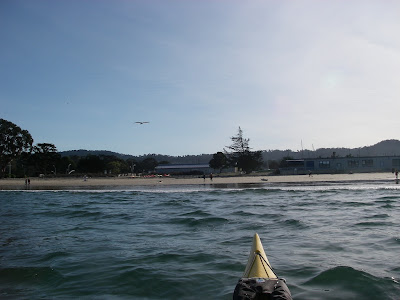
We headed out into Monterey Bay proper and spectacular conditions.


Almost immediately after leaving the entrance to Elkhorn Slough we ran into a bunch of birds clearly excited about something that was almost certainly food. Pictures of a loose group of birds don't really do the groupiness of them justice I think, but there were a whole bunch.


Sadly I'm confident in only identifying a few kind of sea birds, but there were lots of different species represented in this bunch.

After we'd paddled for sometime we ran across another sea bird I can identify, at least in the general sense.


We were a couple of miles or so offshore and, all by himself (or herself, I can't tell) was this guy. I don't know what he was doing although if someone told me he was just enjoying a fine day on the coast I'd totally understand that.

These guys were hanging out just a little further on.


Generally there weren't any other creatures about, at least not that we could see so it was nice to happen upon these guys. It gave the place that sense of life that really makes time on the water quite out of the ordinary, at least for me.

Here's a view of our destination from about the halfway point.


Here's the shore.


And, dead center, here's where we started from.


That's more or less how the rest of the paddle was. Things in front of us got bigger, things behind us got smaller, and things to the left of us went boom with the dumping surf. After about 4 hours and a few minutes some folks get pretty motivated to get off the water. Here's two of our group who rabbited ahead and landed a little while before the rest of us.


And here, finally, is a picture of where we started from a viewed from where we ended at.


Close to the direct center of the far (far, far) shore is were the day started. We ended, as you can see, on a nice beach under a mostly blue sky. We made about 16 miles in 4 hours and 30 minutes. It was a long time to be sitting in the boat and I was, truth be told, pretty happy to get out and stretch my legs.

I don't know if days like this make up entirely for the crowds and cost and noise of California. It helps though. It helps quite a bit.

Tuesday, October 23, 2012

Fun for me. F**k for you?

A little while ago a trip report came through a mailing list I read. Paraphrasing, it contained this passage:

"One of us returned early having landed midway with shoulder problems. (I hope he got back to his car safely !!)"

I cringed when I read this. Was a paddler with a dodgy shoulder allowed to paddle back by himself? Could no provisions to assure he actually got back to his car be made? A phone call? Radio? In risk assessment land (you do do risk assessments, right?) this guy getting on the water by himself would certainly be a giant clump of yellow. Perhaps red. Now, to be fair, for all I know the injured-shoulder-guy never got back on the water. The place he was paddling is a major metropolitan area and, supposing it was not his throwing arm shoulder, from where they landed him a reasonably well thrown rock in any direction could probably have hit any one of a few thousand people or so. One of them might have given him a ride. Or perhaps his shoulder was absolutely, certainly not really that bad and he could make the couple of mile paddle back on his own with no chance of mishap. Or he caught a cab. I don't know for sure. But the circumstance does raise a question I think.

If we're in a shared experience circumstance, do we have any responsibility to our fellows in such a case as this? Suppose, for the sake of argument, the guy was going to paddle back. Is it ok to just let him go? Do we accept his assurances of capability-despite-disability, his you-go-aheads, I'll-be-fines and continue on our merry way? Or do we recognize them for what they could be; demands of social normalcy, ego maintenance, general being-stubbornisms? Do we therefore actively ensure, as far as we're able, the well being of our fellow?

I am a sucker for good animated movies. I think that The Incredibles is one of the finest movies ever made (no, really, I do). I also get quite a kick out of Lilo and Stitch. I won't spoil it for you, but it's set in Hawaii and it's about a girl, Lilo, who adopts an alien (like from space), Stitch, and hijinks ensue. It's pretty good. And, much like Lilo and Stitch, for the duration of paddles that I'm involved with, I try to ensure that I keep to the principle of Ohana. That is, nobody get's left behind.

If someone is not able to continue a paddle, for most any reason much beyond "I don't feel like it", I go back with them, make sure they are on shore and safe and usually, but not always, head back out. In the event this has proven to be entirely a pain in the ass. I don't get out as much as I want to to begin with and now I have to escort someone back because they didn't self assess well enough? Or move at glacial speeds because they didn't know they didn't have the stamina to keep up for the duration? I've actively avoided paddling with some people because I've more than once had to deal with some significant (to me) inconvenience because of them. And because of this Ohana stuff.

But, despite it all, I think Ohana is the right thing to do. I simply can't, for myself, discern any justification for not accepting a responsibility to ensure, as best as I can, that everyone I leave shore with returns safely. If we're sharing an experience well, then, we're sharing an experience. All of it. Even the awful ass parts like you have to head back early because you suck (heh). It's just not enough, I think, to say "It will be fine". I think you have to know that it's fine. For everyone. And, to be entirely clear, "returns safely" does not mean standing on shore back at the put in. It means returns to ones life in pretty much the same state you were in before you embarked on this little jaunt excepting any awesome you accrued doing cool stuff on the water.

Fun for me. Fun for you. Fun for us. Seems fair.

Wednesday, October 17, 2012

resolute

Go read this and come back when you're done...

Certainly I appreciate the candor as well as the (I infer) good intentions of the author. It's hard not to get behind the idea that progress in anything need require only diligent application of oneself. Indeed, baring meaningless quibbles over syntax, I would not be surprised to have found myself to have written the first three paragraphs. I find though that I am forced to take issue with much of the remaining commentary, which I have taken as a somewhat broad condemnation of continuing paddle sport education.

The fourth paragraph starts out stating that it is in an instructors best interest to get students to keep taking classes. Let me suggest that this is rather a narrow view of the issue. I would say that, to the contrary, it is in an instructors best interests to get students to stop taking classes as soon as those students are capable, comfortable and happy within the realms the student wishes to paddle. Happy paddlers are more likely to attract new paddlers and it is this that is in the ultimate best interest of instructors. I know some instructors and they, especially the best of  them, are explicitly and unquestionably interested in getting students off the books and safely on the water having the best times of their lives. And telling others about it. And them.

The fifth paragraph I interpret as a something of a broad based condemnation of the value of experience and perspective of others, specifically the experience and perspective of instructors. In particular I find myself in sharp disagreement with the assertion "...it isn't necessary." when speaking of, if I'm interpreting the text correctly, instruction. Following the logic of the position (i.e. "If you know how to do rescues in flat water (properly), then you know how to do rescues in rough water - you just need to practice") then if one can paddle in a lake one can paddle in a rock gardens, you just need to practice. I believe that is, self evidently, not the case. I will make the mistake of extending my argument into speculation by suggesting that if enough people deem kayak instruction as unnecessary it will, sooner or later, become required by those who have to go fish people out of the water.

The sixth paragraph contains actually a very interesting and, I think, valuable point. That is, "...students are expecting that the class will make them a better paddler. It won't." As someone who in fact thought that way for sometime, I quite agree. Classes, I believe, assist one in becoming a better paddler. A salient point to be sure However the following sentence, "Classes just teach you what you need to do when you go paddling" may be strictly accurate it is, I feel, well overstated, somewhat myopic in it's assertion and perhaps even a little specious. Classes can and should of course teach you what you need to do. However they should also teach you what is possible. What is to be avoided. And why. A class should help you to consider things about paddling even when you are not paddling. Provide a basis for arriving at a taste or to form an educated opinion about a circumstance that was not specifically covered in the class. Classes should help give you the tools so you can help yourself to become better.

The final paragraph, as it is clearly an expression of personal position and not an assertion about the larger world, is impossible to argue with. However I would offer one, not slight, change in wording and thus, perhaps, postion. This statement, "...I will do everything I can to make sure you don't need to take another one." might be written as "...I will do everything I can to make sure you don't take anymore than you need."

Like I said, I think the author is quite well intended and I think that I understand his perspective and position. But again, as I read it, it seems to be an overly broad condemnation of continued paddle sports education and could I think be reasonably interpreted as a broad suggestion that paddle sport instructors are cynics seeking students to "keep pumping money into the system. This, generally, has not been my experience. I have taken many classes and have learned something useful in most all of them. I have worked with many instructors and have come to consider most of them competent professionals performing a fair service for a (actually less than) fair wage without any overly mercenary intentions. I am resolute in my belief that what I've learned in those classes has materially aided me in being a better paddler, having more fun on the water and expanded my horizons with respect to understanding the possibilities open to me.


Wednesday, April 25, 2012

We need a maxim or something

A long time member of the club I'm in announced a trip that sounded like a lot of fun. So I went. We were supposed to meet at such and so time but the place is kind of far away and, as can happen, the organizer was a little late.

Now amongst the waiting participants was one of the most aggressive paddlers that I've met. Very type A personality, gung-ho sort of guy. Like he pulled his 16ish foot plastic boat off his car by himself ("naw, I got it, thanks"), threw it on his shoulder and ran (seriously, he ran) thirty plus yards across the sandy, sandy beach and, gently, deposited his boat at the ready. Gung-ho indeed.

So we are all on the beach organized to go, chatting kayaking chat and waiting for the organizer to catch up, he having arrived a little late as mentioned. Type A guy declares that he's going to head out, by himself mind, but he won't go around the point. It's not at all clear to me which point we're talking about but it doesn't really matter, something I tried to convey in the tone of my "Really?". You know that you-sound-serious-but-I'm-having-a-hard-time-believing-it tone. Not surprisingly  this elicits a "yah" response with not entirely subtle undertones of well-duh  (type A you'll recall) . As a last resort and with little hope I break out an "ok" smothered in this-is-not-a-good-idea. Unfazed, Type A picks up his boat and heads to the water. Sigh.

A few minutes later the trip organizer joins us and we start in on the safety talk.The beach we're on is notoriously dumpy. On this day it's really small, but perfect for a speed launch, which Type A undertakes. The salient point of a speed launch, at least for this story, is that you get your boat into the water and cowboy in as opposed to knuckling down the beach. Type A jumps on the back of his boat in a buncha feet of water, is clearly not centered and, after a brief struggle with gravity, falls in. Happens to all of us. I turn around to pay attention to the signals portion of the safety talk.

I was surprised when I glanced back out to see Type A, still in the water, pushing the bow up to empty his cockpit. The water is cold, dry suit or not, and this would not have been my choice. But, despite it all, there's no doubt Type A is a strong and experienced paddler so, like, whatever. You know? Back to the talk...destination...communication...together...

Hey, Type A, is still in the water. That was unexpected. I figured for sure...hey, he's actually swimming after his boat. His upright in 5ish knot winds boat. Umm, the boat is looking to be the easy winner of this race...oh he stopped swimming and he's on his back. Damn. I've seen this before. In a class, as a staged scenario, but still I grok this is a real situation. Neat!

I say neat because, well, it was and because I figure there's about 10 minutes before Type A is going to be even near anything like trouble. He's being blown towards-ish shore, he's dressed for immersion, he's perhaps 200 yards away, and despite admitted limitations in various other paddling skills, incident management like this is something I've done a lot of training in. Which is to say, quoting Spicoli, I can fix it. Probably needlessly I announce to the group that "he's in trouble" and grab my boat and head down to the small break intending to paddle out and, well, fix it.

In the event I didn't really have to do much. Turns out that a whole bunch of California State rescue employees of some sort were there for training or something and, while I was waiting for an opening, a Zodiac type boat comes from across the bay to help out Type A. Meanwhile one of the rescue employees, a kid, no more than 25, comes jogging over, all blonde hair and, no shit, blue eyes and asks, "do you have a leader?". This kid things we're fools and incompetents. A fair judgement given what he's seen, but I'm embarrassed and manage only a short "what?" before I see my chance and get on the water, leaving the rest of the group to deal with this kids well intentioned questions.

Type A of course was fine. The rescue guys helped him get back in his boat, he pumped it out, etc. Fine. I was a little embarrassed in front of the professionals and the conclusions I can imagine they came to. But mostly I was shaking my head. I mean, and I am not at all a fan of hyperbolic what could have happeneds, the whole thing could've put a serious crimp in my day. Just to get on the water maybe 10 minutes earlier. Which got me to thinking.

There was this really successful and famous (if you're a college sports fan) coach named John Wooden and he had a bunch of maxims. Like "be quick, but don't hurry". Catchy (says I) and actionable sayings. I think we need a catchy maxim or two when it comes to safety stuff. Like, "saving 10 minutes could cost you a lot or otherwise put a crimp in someone else's day which is terrible if they don't get out to paddle enough". You know. Catchy.

Friday, April 6, 2012

Maintenance

Cleaned my boat the other day. Washed and waxed.

I like cleaning my boat. It's just so....certain.

Tuesday, March 27, 2012

Planning sickness

Planning trips is something of a sickness I have. Sad to say, but the fact is that I plan way, way more trips than I actually do. Whether it's a day trip on the weekend or an overnighter somewhere along the coast it's still the case that finding time to go is always difficult. Still, plan I do.

Over the years the tools I've used for planning have varied. As little as a few years ago getting (real) charts on a computer screen was something of a pain. And getting tide and current information on the same chart was something I had a really hard time finding. These days of course there are all kinds of choices, at least in the U.S., for getting NOAA chart and Google maps mashups. The final frontier was a decent tool (set) for my smart (read "i")Phone. I have I don't know how many tide and weather apps, current apps, ship finders, and so forth. Just a bunch of disparate tools that I can potentially use to plan in quite fine detail some outing that probably won't happen. But nothing cohesive, no "one app to bind them all".

The smart/iPhone situation has changed though. I happened to spend some time with Ben Lawry while he was at the GGSKS. In addition to being a pretty damned fine coach Ben has the (I say) admirable quality of being something of a gadget geek. He has an iPad and a smart (not "i") phone and turned me on to an app from a company called Navionics. For $10.00 it has downloadable charts that auto stitch, has tide and current info on the chart, a community layer (they call it) where it looks like you can add your own icons to the chart and share them, and a entirely livable UI. You can plan and sport routes and it will create exportable tracks using the GPS.

The number of tide and current stations is a bit lacking, the charts are a little jagged edged at large scales and a little cluttered at small scales. I wouldn't want to plan a serious multiday with it and I guess Navionics wouldn't either since it has a big green "Not for Navigation" type warning when the program starts, but for those "hey, what should I do this weekend" questions, or over beer what abouts, it's totally reasonable. Hell, I thought it was worth $10 just to not play Angry Birds or whatever quite so much. Getting something I can plausibly pre-plan a trip with on my ("i")Phone is gravy.

Sunday, March 18, 2012

GGSKS

It has been just a helluva long time since I've posted anything here. I've been in a bit of a kayaking funk for quite a while so I just really didn't feel like I had much to say. Not that feeling like having something to say is the same as actually having something to say, but I digress.

I think one of the things that most got me back to the path of enjoyment was the Golden Gate Sea Kayak Symposium (GGSKS for the cool kids). To be honest I wasn't even going to go this, the fourth, year. I'd been to the first three and I had a really good time the first two years but last year was just a bummer for me. The reasons why probably don't matter much, even if I could say what they were exactly.

A friend of mine, Leon (of Leon and Shawna fame), cajoled me into going though. Kind of a gotta support the team thing, an argument that I'm pretty susceptible to. I think he knows that. Anyway I'm really happy he made the effort, I think this was the best GGSKS so far, at least as far as I'm concerned.

I didn't stay at the hostel this time, and I think that was a great idea. From my perspective the hostel is the best and worst part of the symposium structure. The best part is that it's where most of the attendees and coaches stay so it's just a bubbling cauldron of kayaking. The worst part is that, for me, it's hard to get a good nights sleep there. So I ended up staying in a hotel just a couple of minutes up the road. It was way more expensive than the hostel to be sure but it was entirely worth it.

Another good choice I think i made was how I managed my schedule. There's just a shit load of really great classes offered. But the fact is the most exciting are also the most exhausting. So I sort of did easyish, hard, easy. Day one was an edge control class with a possibility of getting into some conditions to work on that stuff in the realer world. Day two was an incident management class which I anticipated would be strenuous (and it pretty much was) and the last day was a coastal journey that I had some confidence wouldn't be coastal due to conditions and so would be pretty easy (and that's what happened). In previous symposiums by the last day I'd be completely knackered and that just sucks. Not this year, and that was really great.

So, more or less, those were the things I did to make the GGSKS a great time but the organizers seem to have things pretty well dialed now and that totally helped. The coaches were, by all accounts, exemplary. And for the first time classes had an attendee limit. Heretofore one could sign up for a class and have 25 people in it (happened to me once). Sometimes it worked out fine (happened to me once) sometimes not but limiting the class size made that a moot concern. One of the things I consider when picking a class is the coach(es) so knowing that when I sign up for a class with XYZ coach I'm going to have XYZ coach teaching is nothing but win.

Anyway, yah, I had a great time, I'm energized about padding again, planning trips and such, met some hella cool new people and spent time with old friends. Hard to beat.

Sunday, November 20, 2011

A couple days of Bragging

For the longest while I've been looking for a surf (kayak) coach in my area. Surprisingly this turns out to be difficult despite the fact that there are several world champions nearby. I suppose spending time practicing and not teaching has something to do with why they're champions though.

So I happened upon a mail from Jeff Laxier of Liquid Fusion Kayak that was sent to one of the local paddling clubs announcing a BCU 3* training and assessment coming up. I'm (probably) off of the BCU path but trainings are always fun. So I hit up their website and see that in addition to the 3* training Jeff is also doing a surf (kayak) class. LFK is in Fort Bragg which is about four hours away. So not exactly in my neighborhood but, hell, I drive up to the San Juans several times a year and that's a fourteen hour slog. Four hours would be a cake walk. I'd met Jeff once or twice before but we didn't really speak. I mean he seemed like a nice enough fellow but I was looking for a coach and, for me, that has requirements well beyond just "nice enough fellow".

Getting in touch was a little touch and go. I sent a mail and it took a day or so to hear back. I learned that the 3* training and assessment had been cancelled due to lack of participation (symptomatic, says I, of the paddling culture in my area. But that's another topic). I sent another mail and waited another day or so. I was feeling a little neglected. The Saturday before the surf class was supposed to happen I paddled down to Capitola and called LFK from the beach and got a chance to talk to Jeff. Long story short the surf class was undersubscribed as well but we could do a private lesson. Ok let's do that. While I was willing to drive four hours (eight total) I wanted to spend more than three hours or so on the water,  so a surf class on a Monday and a sea boat lesson on Tuesday it would be. Basically if my time on the water is going to be less than the time of a one way drive to the put in I (usually) don't do the trip or whatever it is.

I've never been to Fort Bragg. I'd been to Mendocino before which is a real tourist type place a little ways south of Fort Brag (30 minutes perhaps? I dunno. Not far.) I thought about staying in Mendo. It's a really nice place with good restaurants, nice places to stay and truly iconic California coast scenery. I took a look though at the lodging options in Fort Bragg and was very(!) surprised to learn how cheap things were. At least relative to Mendo. I ended up making reservations at a place called Shoreline Cottages for two nights in the Sun Suite. Nice place.

I arrived in Fort Bragg about 2:45 on a Sunday. My room wasn't quite ready so I decided to take a drive up Highway 1 to see what I could see. I randomly made a left hand turn, towards the ocean, and happened upon a parking area on the side of the road that contained several cars and an obvious path towards the water. I parked and in about 5 minutes I was on a cliff about 15 feet above 2 beaches readily accessible by well cut trails. I wouldn't want to carry, say, my sea boat down the trails by myself but would easily do it with someone else and, if I had really, really had to, by myself. This was my first exposure to how easy it was to get to the water in Fort Bragg. I stopped under the bridge that goes over the Noyo River. Easy access. A little further south, more or less across from the hotel, easy access.

It wasn't clear to me exactly where this surf class was going to be the next day. I sent a mail over to Jeff and he replied that he was going to check conditions later in the day and would let me know where the class would take place. This was a very good sign. Adapting to conditions is sort of a minimal requirement for a class and coach. That evening Jeff called and left a message telling me the course was going to be at place called Caspar Beach. Meeting time was 10:00AM. This, by the way, is a time I find entirely civilized for a class. Oh yah, another student was coming and the private lesson was now just a regular class which was great since it ended up saving me some money.

I arrived at Caspar Beach about 9:40 the next morning. Low and behold it was another easy access site. Incredibly easy actually. The waves were perhaps 2 feet or so which I thought to be a good size for a class like this. Jeff arrived at around 10 as did Sean (sp?) the other student. Jeff brought me a Kaos sit on top surf boat. I'd been in this kind of boat once before and I'd been happy at not having to worry about dealing with spray decks and like that.

Jeff spent quite a few minutes discussing surf stuff. I've been in the surf before so I don't think there was much that was new to me, but I really (really) appreciated how he talked about surf etiquette. Several times he used the words "ambassador to the sport" as in be a good one for surf kayaking. My regular coaches say this quite often and it suggested to me that Jeff was trying to convey a broader view of surfing than just catching waves. I like this.

I won't bore you much with the specifics of the class. Jeff was, I thought, a solid and conscientious coach. It's the little things you know. He would start talking to me and realize he was in the sun and move. Safety. Safety. Safety. Always concerned about safe. See that log there on the beach? What's going to happen to it when the tide comes up? Keep an eye out. Aware. Be aware. Watch the waves. No, keep watching. A little longer. Just well paced absorbable presentation. And not too much verbiage.

The class ended for me when I got slammed pretty hard. I was on a foam pile, bracing into another foam pile and the one I was riding just sort of disappeared. My shore edge caught, I got whipped and dropped right on the top of my helmet onto smallish rocks and coarse sand. I saw stars and when I got up I had one of those sharp headaches you have the morning after drinking a lot of bad scotch. My shoulder had a nice welt and bruise on it from hitting something or other. It was mostly shore break at this point and my head hurt (without the conciliation of being at all drunk) so I decided to just watch. About 20 minutes later we were done.

The next day I was to spend a couple of hours in my sea boat with Jeff. We met at LFK central which is right on the Noyo River perhaps a mile from the ocean. Nice location with (surprise!) easy access to the water. We put in and headed down to the highway 1 bridge. Jeff had me doing some stuff with my feet that was really interesting. I think it's the first time I've paid exclusiveish attention to my feet. Quite eye opening and I took several things away that I want to play with.

While I was happy with how I connected with Jeff in the surf class I was truly pleased at how well I took on his sea boat instruction. I'm not an expert coach or anything but I have some notion of good practice. Things like being quiet. Speak only when looked at. Which is to say, some idea of how to get out of the way when I'm learning, and then how to present so I can learn.

So anyway it was, in the end, a great couple of days. Fort Bragg was a pleasant surprise. It's inexpensive, has great access to a beautiful coast and, evidently, good surfing. It's a shortish drive, one that I'd do after work on a Friday, at least every now and again. I might have found a surf coach. While it's hard for me to say, after such a short time, if Jeff will be a good coach for me I'm confident he won't be a bad coach. I'll be going back to Fort Bragg and LFK for sure.

Friday, November 11, 2011

CLAPing and Towing

(This is long. Sorry I just didn't have time to make it shorter.)

One of the spans of the San Francisco Bay Bridge is being rebuilt because apparently the old span will not likely survive a big earth quake. It's been under construction for a really long time so I decided to lead a club trip out to the bridge so we could inspect the progress being made. And also because the bridge is quite a spectacle. Awesome in fact. But awesome in the dictionary sense of the word, not the current colloquial sense. One of the participants had to be put under tow for about 2 miles or so and, in that process, I made some mistakes and learned a few things. I thought I'd write them down.

Conditions were quite tame. Predicted winds were SW 5kts. Currents were relatively light, 1.33 knots max flood under the bridge itself and those not until 3.5 hours after we launched (assuming the nominal 3 miles per hour rate).It was sunny and the air temperature was predicted to be in the low 70s. Fall on the bay is full of days like this. Just...nice. It was a nice day to be out on the water.

The plan was to circumnavigate Treasure Island and Yerba Buena Island in a counter clockwise direction, arrive under the bridge and eww and aww at it for a bit and then head back to our put in. I'd estimated the distance at about 10 miles with a guesstimate time on water of a little over 3 hours. Our route took us across the current and then only if we were quite slower than I'd anticipated.

I'm moderately religious about doing a safety talk before a paddle. Unless I'm alone. Then I don't do a safety talk because that would be strange and I'm strange enough already. Or so I'm told. Anyway sometimes the talk is as simple as "Don't die, stay in shouting distance". Other times I cover signals, closest to a capsize handles it, everyone holds position when a rescue happens, etc. It really depends on who is there, where we are, stuff like that. Environmentals if you will. But always with the safety talk. My preference is to do it on shore for various reasons but on this day that wasn't possible as folks just got on the water. I asked them to stay close by the for the safety talk though.

After we got on the water I covered our route, the estimated distance and time, and asked everyone to stay in shouting distance with the request that if you didn't see anyone in front of you please look behind you to make sure you weren't rabitting away. For myself I had my "don't ask just pack it" kit and part of that is a tow belt.

We crossed fairly directly from our put in to the east side of Treasure Island. As we approached the island there is a channel that larger (than us) pleasure craft use. It was a slow day with not much traffic but I maintain that practicing good practice is good practice so I gathered everyone up in a bunch, explained that this was a channel (just in case) and told them I wanted to cross it together. This was accomplished somewhat but by the time we got across the group had dispersed fairly well in both dimensions. This was a sign to which I should have paid better attention.

The northeast tip of TI has a current on it that can sometimes be insurmountable. Today was not that day but I'd estimate there was a current of about half a knot or so. The water was soft and swirly as it gets around sticky-outty bits. I headed around first, but stopped in the soft water so as to not loose sight of anyone. I did not ask anyone to stop and wait  once they got around. Once the last person got around I just paddled along myself and soon found myself at the front of the group. As we approached the north west tip of the island I stopped again to watch for everyone to get around. This time when I looked back though one of the members was quite a ways back. I don't recall the exact distance but almost certainly more than a hundred yards. That's too far, at least for me, since I had no way of communicating with this guy and that's just a really bad thing. Says I.

I held the group up to wait for the slow fellow. Another of the group members had stayed fairly close to him and he relayed to me that he'd asked slow fellow if he was nervous in the conditions or if he was tired, or what. SF said he was a little tired. Once he caught up we continued down the west side. I talked with SF briefly and he also told me he was just tired. I was right next to him at this point and watched him carefully. I deduced he was in fact quite uncomfortable with the conditions. His focus point was on his bow and close to the water around him, he was fetalizing and his form was stiff. If he was tired it was a decent bet that was a significant factor in his fatigue. We were about half way into the paddle. I have quite an appreciation with being nervous in conditions so I informed him that once we got around the southern tip of the island things got flat calm. Knowing that the end is in sight, so to speak, has always made things a little easier for me.

We stopped for lunch on a small beach that was absolutely not on Yerba Buena Island because that would be trespassing on Coast Guard property and that would be wrong. So we didn't land on a rocky little beach under the bay bridge were we couldn't be seen from above. And we didn't have a snack or lunch on a beach like that. I didn't have lunch with me. I'd really been expecting a short 3.5 hour paddle at most and so had brought only some snacks. However the impact of SF was that we were about half way into our paddle and we'd been out for 2.5 hours. Beyond insufficient food of course was the issue of currents. I'd assumed(!) we'd not have to worry about currents much at all since we'd be back on shore by max and out of the main flow well before the 90% hour kicked in.

I sat down with SF while were weren't on a beach on YB and again told him conditions would be flat calm after we got around that point right there (I pointed to it). I asked if he was ok, and was he tired and so forth. I mentioned that the current was going to be a little bit more than I'd planned and I might put him under tow if he was too slow crossing it. He didn't seem happy about that but didn't reject the idea.

Once back on the water and around the corner SF seemed quite rejuvenated. He stayed within a couple of boat lengths of me as we went under the bridge and when I gathered everyone again for the crossing he was right there. I started the crossing and fairly quickly the group had split into fairly wide spread groups of 2 and 3. Even though it was just a 1 knot current I decided not to stop and collect the group in the middle of it. So I lost sight of people as they went behind barges that are there to hold bridge building supplies. I chewed my lip until they came back into sight. I cursed club paddle politics. I really, really cursed a paddling culture which seems to violently eschew professional training. Sigh.

After a while one of the paddlers (a BBB alum BTW) who had stayed with the main group (i.e. me) mentioned that folks had spread out a bit. She was right of course but I explained I didn't want to stop in the middle of the current and, to myself, I was sort of not in the mood to herd cats. Things would probably work. Probably. I did though take a look behind me at that point and saw, to my great sadness, SF about two hundred yards behind me.

He was tired. He'd paddle two strokes and then put his paddle down. Two strokes, paddle down. Fuck. Just fuck. I paddled back to talk to him and, fuck again, snap a tow on. As I approached I asked, pointlessly, how he was doing and he responded, pointedly, "tired". He asked how far it was and I told him about 1.5 miles. He commented that he could make it. I just didn't feel like explaining that we were in a current being set down and at his pace the 1.5 mile was going to be rather a bit longer. So I just told him I was going to put a tow on for a little while and let him catch his breath.

I started towing and, after about 2 hours (read: 10 minutes or so), received an offer from two folks to assist. One I was forced to turn down as his tow system consisted of 30 feet of line with two carabiners on it. I'm not sure how bad things would have to be for me to attach myself to another craft in that fashion but much worse than they were right then. I did accept the offer for an assist from someone who had a quick release tow system. So it was SF, me in the middle and the helper. Everyone else continued paddling and they were soon far, far ahead. Entirely out of touch.

Thus began the long (long. No longer than that. It was long. Or it seemed long) slog back. The helper guy was no doubt helping but he happened to be using a greenland paddle and I was pretty much constantly over running him. I think this disparity in ability to apply force (greenland versus the fat ass euro blade I paddle with) has some profound implications. One thing that was immediately obvious was that I was glad I was in the middle of the tow. Strictly speaking I should not even have been in the tow. I certainly should not have been in the middle where I was essentially unable to disengage on my own to address other circumstances that might arise. However, in this case, had I been at the front I would have been towing two boats for much of the distance.

Total time for the tow was about 50 minutes or so. I was exhausted when we got back into the flat calm protection of the spot we launched from. Thankfully nothing else happened. My ability to influence a circumstance on the water was severely diminished. If SF, for example, had ended up requiring a rafted two I'm not sure if I could have towed the raft back myself. (Remember the rest of the group was gone, far ahead.)

This was my second time towing for real. The first time I was not the leader, and the tow was short, perhaps 10 minutes. I had huge amounts of support around me (Ben Lawry and Sean Morley). They kept the group close by, etc. and therefore I was only concerned with towing.

This time it was me and I had to be concerned with the group and the towing. Ultimately I failed. SF was returned safe and sound but I pretty much lost control of the group and, as I said, I was at my limit when we got back and that's just not where you want to be if you've some sense of responsibility to the group.

In the end I think I did several things wrong. As soon as I saw SF was not able to keep up I probably should have adjusted the trip to be shorter. My admonition to the group to stay in shouting distance was insufficient. Ideally I would have liked to have said the trip would operate under the principles of CLAP, but few participants would have known what that means. I have another introduction that I'll use in future. When folks started getting far in front during the tow I should have called them back. Not doing so allowed for an unsafe condition to arise. I succumbed to club paddle politics which is to say that I didn't want to rag on folks to do things "correctly". I put that in quotes for obvious reasons but I'll stand firmly by the notion that staying in a group, adjusting trips to accomodate individual paddler requirements and striving to be not exhausted is "correct".

I do wish more folks took the time to learn what CLAP is, why it is, and it's value. I would be very happy if "competent member of a group", when it comes to kayaking, wasn't translated into "I can paddle in those conditions". They are, I believe, very different things.

Finally, ultimately, some might say this whole thing is a little pedantic. Truly the San Francisco Bay is a pretty safe place to paddle, at least in most of it, and so long as you don't get run over. There're tons of people around all the time, there are something like 10 billion outs (more or less), the water isn't that cold, etc. If I hadn't towed SF guy the most likely worst case outcome would have been he'd have gone under the bridge, hit land and called a cab for a 15 minute ride back. So pedantic, maybe. But I see no reason not to think about how to save cab fare.

Tuesday, November 1, 2011

Rescues should be inevitable

A couple of weekends ago I attended a rescue clinic put on by BASK, one of the local clubs in my area. The last time I tried to get to one of these I was rear ended on the way. After trading info and rest of the rigamarole that goes with getting hit I ended up missing the event so I was happy to have the chance to practice some rescues as well as meet some new people (I don't usually paddle with BASK, but that's a different story.)

The practice took place at Half Moon Bay. The plan for the morning was to be practicing/learning various rescues in the flat conditions of Pillar Point Harbor. After lunch everyone was to do a short portage over to a cove that's protected by a reef. It was a very calm day so the waves were very small and manageable by pretty much everyone. One person though did swim and I happened to be closest so I went over to offer some assistance.

As I pulled up I asked him first if he wanted any help. It was a rescue clinic after all so perhaps he wanted to cowboy back in or something. I don't recall exactly what he said but it wasn't an answer to my question. I asked him again if he wanted help and, again, got an answer that really didn't answer. Something about how the wave surprised him or something. Briefly I was concerned he was genuinely disoriented but decided to ask one more time and, finally, got my answer. Yes, he wanted some help. Whew. I'm entirely able to get someone incapacitated back into their boat, but I've never even thought about how to deal with someone in distress but actively unwilling to assist. Not to say that's where the guy was, but it crossed my mind. Something new to think about.

Anyway I ask the the guy to flip his boat over (because that's how you do a standard T-Rescue dammit) and immediately I start getting lip. He might get water in the boat. His head might go under water. I tell him it'll be fine, just flip the boat over. So he does and I grab it. He swims to the back of his boat for whatever wrong reason and proceeds to start telling me what to do. He's going to push down on the back or something and make sure I have a good hold on the boat and like that.  I realized, all of a sudden, this guy has been either incredibly poorly trained or he's never been trained at all. So I started laughing, and I tell him that, this time, I'm going to let him get away with giving orders, but the rescuer is in control of the rescue. He says ok, and then tells me to grab the boat and hold it tight he's going to do a heel hook. I asked him to wait, emptied the boat and then he heel hooks in. While he's getting sorted he tells me to not let go. I'm actually guffawing at this point because it's just funny as hell this guy is out on the ocean. Anyway, he explains that the last time this happened the rescuer didn't hang on and that caused problems and blah, blah, blah. It was hard to hear him. I was laughing.

As the world is made up of little more than a seemingly random series of coincidences (heh) a couple of days later I received the new Sea Kayak Rescues DVD put together by Body Boat Blade. (Full disclosure. Leon and Shawna are friends of mine. I'd like to think though that if I didn't like their movie I wouldn't say anything at all in public. I have no vested interest in the DVD so I'm not shilling here.) Let me digress a bit and talk about the movie.

I've watched it five times already. It is unquestionably different than the other instructional DVDs I have. For one, at about 26 minutes long (not counting some extras) it's quite compact. I have other instructional DVDs that are 3 times that long. (Interestingly the longest one I've watched twice in 4 years.) It's also not a "talking head" movie. That is it's not one of those, "Do this. Then this. Now that. But if that occurs then this." type movies. I'll be honest. The first time I watched the movie I didn't get it. It was shorted than I expected. There was less talking than I expected. A lot less talking. It didn't follow an arc I expected.

I've mentioned this before, at least indirectly, but if you can get those guys to talk about coaching (it's not hard) you sort of quickly realize that,  pedagogically, very little that they do is not planned or considered.  If you're in a class and they're doing something it's probably for a reason. To this day I will tell anyone that asks one of the best classes I ever took was one in which Leon never got in a boat, and never said more than like 10 words in a row to any of the students. If the movie was odd it likely wasn't due to a lack of consideration.

I'm not sure but I think the movie is important. Not because of the content, which is of course important because it's about rescues. Rather because, perhaps, it might change what people consider an instructional DVD to be. Notice please I said might. I'm not an expert. I am however getting something out of the movie each time I watch it. And it is certainly something to watch. Actively. Attentively. At least I think so.

Anyway, in this movie Leon says something like, if there's one word I'd use to describe our rescue philosophy it would be efficiency. Shawna uses the word simplicity.

After I watched their movie I was reflecting again on my experience with the guy in Half Moon Bay and came to my own one word summary of a rescue philosophy. As far as possible rescues should be inevitable. I wish his experiences had let him think that was true.

Monday, October 10, 2011

I lost my grease pencil

A few weeks ago someone in my club proposed a trip along the coast of Big Sur. My time on the coast is pretty limited and so, as much as I wanted to go, I decided not to go. A few days later I discovered that the trip was going to be led by one Roger Schumann. Roger is a sea kayaking fixture here in NorCal and there is little doubt he is about as experienced on the California coast as they come. I sent out a few feelers to make sure my serious lack of coastal experience wouldn't slow the rest of the participants down and I was happy to be informed me being there would be fine.

There are not too many things I like more than planning a trip. Even when I'm not planning the trip I like to plan as much of the trip as I can. So while I had no real idea about where we were going except stuff like, you know, put in here, take out there, I dove into planning my menu, checking all of my gear, reading about the natural history of the place (really interesting it turns out), stuff like that.

As the day to depart got closer various details finalized. Things like who was going, and how we were going to organize the shuttle since this was a one way trip. In the who was going department there were to be, all told, 8 of us. Roger, his wife Sandy, Bryan the co-instructor/leader, Patrick, Peter, Dick, Doug, and myself. I had paddled with or at least met everyone except Sand, Bryan and Doug, or so I thought. It turns out I had met Doug very briefly on Orcas Island when he had come into the Body Boat Blade store while I was in charge of it while Leon and Shawna were out somewhere. Small world.

The plan, roughly, was this; We'd meet at a place we call Monastery Beach on a Saturday at 7AM. 4 of us would drive about 55 miles south and drop our cars off and get driven back by Patrick's wife (to whom major props and huge thanks). Then we'd all put in and spend the next 7 days paddling down the coast finding stuff to do. We'd spend each night at a different beach except for the second and third nights, when we'd stay at one place that had a large number of very accessible play spots.

This was of course a fine plan. For myself (and Peter I think) the 7AM meeting time was a pain in the ass. I live about 2 hours away from the meeting place so, adding an oh-shit factor to account for accidents, construction or other vehicular interference, I had to get up at 4:15AM. Sleeping is not something I'm actually very good at and sleeping the night before some cool adventure type thing is about to happen is something I'm flat out horrible at. In the end the last time I recall looking at the clock was 1:00AM. 4:15AM rolled around, the alarm on my phone played Marimba for me and I was on my way. Still asleep but energized by the forthcoming adventure.

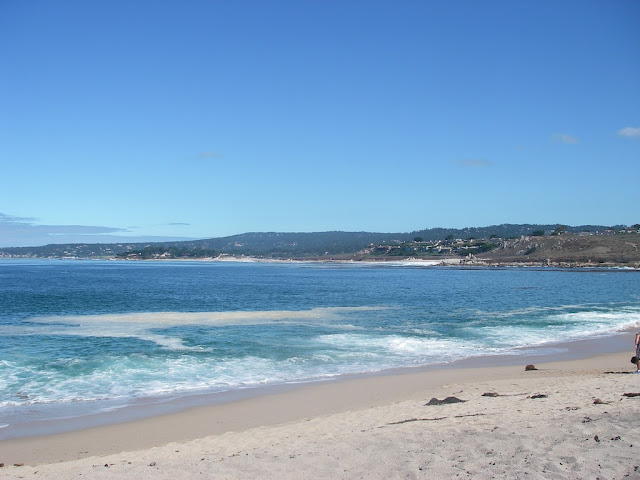
I won't bore you with the details of the drive down, or setting up the shuttle or any of that crap. Rather let me just jump to it was a spectacular day. Here's a picture of Monastery Beach, our launch point:


Now this is a pretty remarkable sight actually. Monastery is a really (really) dumpy beach so having such absolutely easy put in conditions was a great surprise and a treat. The weather was fantastic too. Here look:


That's right after we put in. The peninsula thing in the background is Pt. Lobos which evidently is famous as a sight seeing destination.

Here's a picture of the very first tunnel I ever paddle through. It's not much to look at and of course the conditions are very tame, but it was damned cool.


This is the beach we had lunch on the first day. We're waiting for someone to finish up on shore there.


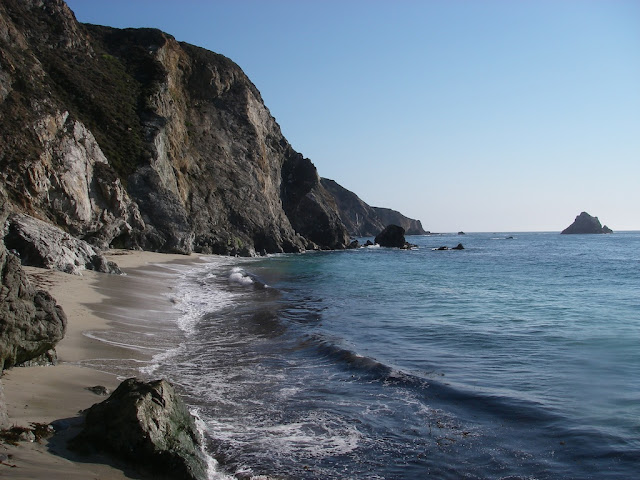
Some houses right on Highway 1 somewhere south of Carmel. They went on for a mile or two like this. The houses seemed mostly empty and mostly souless. Like a sad enclave for lonely rich people. It was kind of a downer. Nice houses of course, but I think I'd have preferred the rocks instead.


The place we camped the first night was actually pretty small...


...but the view was pretty excellent. 


This picture doesn't do it any justice. It was here though that I started to realize that I had made different choices than some of my colleagues. Without going into it very deeply, a few years ago I was out on a multiday with some folks from Mt. Vernon, WA. On the fourth night they made sushi. No, really, sushi. They had the rolling matt thing, the rice, sea weed and all the other stuff you shove into sushi. They rolled up sushi things, cut them and ate them. A seriously bad night years ago in Okinawa that involved a bottle of Suntory and some slimy things wrapped up in slightly less slimy things has left me anti-sushi, but the effort was impressive. Since then I've tried to be a little more adventurous cooking wise when I'm out.

So dinner on the first night was spaghetti and meat sauce. I'd put a thing of frozen meat sauce in the bottom of my boat in the morning and it was of course defrosted by the time dinner rolled around. The inevitable "what's for dinner?" conversations started and when it came to me I got the whole "meat sauce?!?". Surrounded by Jet Boils and dehydrated food wrappers and singe pot dinners of various sorts I suddenly had the feeling of being a little out of place. Sort of like declaring support for extraordinary rendition during an Amnesty International meeting. Just out of place. But nobody said anything and the night concluded passing around a bottle of rum Bryan had brought. Crisis of segregation averted. For now.

The next morning was overcast with a light fog as we usually get along the NorCal coast, but it cleared and by about 11AM it was obviously going to be another glorious day. Our schedule was incredibly leisurely. I made coffee of course. I used a filter (#4 cone) with Peets Major Dickasons. It's good but it was observed in passing that some others were drinking "cowboy" coffee. I gather you just put coffee in a boiling water or something and drink it. Boiled eggs were on tap this morning for me. I'm not sure what others were having. I just sort of kept my head down drinking my evidently fancy-for-the-moment coffee. I think we got off the beach around 11:30AM or so. Not having currents to deal with is pretty great. We did have a rescue right off the bat, here's a picture


but it was a simple affair and, after discussing strategies for getting folks back in their boat while also dealing with rocks in close proximity, we headed down the coast. Distance for the day was to be about 5 miles down the coast but that translated into about 10. miles after going in and out and around stuff along the shore. Doug, who had been identified as the "wave magnet" the day before by Roger, got caught inside and was swept up onto a rocky shore. No damage to Doug but his boat was a little bent up. It was along this portion of the coast that I learned perhaps the most important and valuable lesson of the whole trip.

Around 12:30 or so Roger pulled his boat up on a really small and rocky pocket beach for lunch. It was as simple as can be to land on. He was voted down though, with everyone saying to continue for an hour or so. After a little over an hour Sandy declared she had to get to shore for a pee break, and someone else said they really needed to eat. The problem was that our easy pocket beach was too far behind us to get to quickly. The beach available to us however was pretty rocky, quite exposed and periodically some 3-4 foot dumpers were hitting the beach. Long story short, Dick and I elected to stay on the water. While I carry a repair kit that has sufficient stuff to allow me to (temporarily) fix big holes in my boat, I didn't want to risk it. As well my experience landing in dumping waves like this is very, very minimal and I didn't want to risk injury. Neither did Dick. Bryan, the co-instructor, came out to hang out with us while the rest of the crew ate and peed.

Back underway we played a little bit on the way down to our next campsite which was a meer 2 miles down the coast now under one of the iconic bridges built in the 1930s along highway one. Here are a few pictures of what the landing conditions were like:


(keep these in mind. It's important for later.) And here are some pictures of the spot we camped at:


Once we landed I broke out a much needed lunch having eaten only PFD pocket snacks waiting on the water. One of my (much anticipated) lunch items was a Coke. Understand we'd out for a grand total of about 30 hours at this point so it's not like it was having a Coke after, say, a week or more. But still, I think most Coke drinkers would agree, the enjoyment of a Coke can be a very situational thing. This was one of those situations. When that luxuriously snappy crack of the top being popped resounded around the beach one of my paddling partners noted, "I'd really like a Coke right now" with that oh so gentle tinge of "hey, what are you doing here with that?". As I walked down to the water with my Coke to admire the view I couldn't help feel just a little further away from the Coke wisher than I had before the pop of the can. And maybe, just maybe, that feeling of eyes boring into the back of my head. But I didn't turn around. It's safer that way.

Roger and Patrick decided to head out again after a brief respite, but the rest of us were done. It was a truly pleasant day on a beach with no humans. Sitting there was a pleasure derived from the work of getting there and I for one was quite happy to reap the rewards of my meager efforts.

Dinner that night for me was thankfully simple. Red beans and rice with andouille sausage. Everything in one pot. Easy. And it kept me, logistically speaking, much closer to the rest of the crew. Nobody seemed to notice that it took about 25 minutes for mine to be finished. I did manage to attract a what-gourmet-dish-is-on-the-menu-tonight type comment, but other than that I think I fit right in that night, gastronomically speaking that is.

Morning broke a little grayer than it had been, but that was consistent with the forecast. It called for a "chance of rain" today and "rain" the following day. Or something like that. Anyway, it was grayish out. This was our layover day. We were going to go out and play around in empty boats. The rough plan was to head north, futz around in whatever we found, eat lunch, head back south past the campsite and find some more stuff to play in. Finally we'd ride the freshening southerly back to camp. A southerly wind here, by the way, often means a storm is coming.

There were to be two firsts for me on this day. My first cave and my first pour over. Here's pictures of the very first cave I've ever paddled into


Clearly not as challenging as it was awesomely cool but it was, well, awesomely cool.

Here's a picture of the pour over between waves. That's not me there by the way.


Just around the corner from these two features were some more caves and tunnels. This is the second cave I've ever been in


This was actually pretty big. It quickly became too dark for me to see, although some of the others did go further back and in fact found a different exit.

It's probably worth mentioning that at this point we're probably, oh, something less than a mile from our campsite. Play spots abound.

Lunch was at a beach just a little past all of these caves and things. It was a wide, sandy beach. Getting in was incredibly simple. One of the reasons I went on this trip with Roger was to try to learn a bit about sizing up surf from the outside. It's one thing to launch and play in the surf. You can look at it from the outside but in your heart you know it's X feet tall. Landing having not seen the waves from shore is a little more daunting, at least for me. Roger asked if folks wanted help timing their landing and I accepted. After a couple paddle-wait-paddle's I looked back and realized I was in conditions I'd been in many times before. Now I have a little better idea of how to gauge surf size from the outside.

Here's a picture of some of the crew in that surf


Lunch was uneventful. I had another Coke, but I drank it fast and sort of kept my eyes down. If anyone noticed they didn't say anything.

I think I was like the second person off the beach after lunch. The surf had come up a bit, as had the southerly winds. I mis-timed a wave on the way out and got absolutely smacked square in the chest. I know I should have put my head down, blade forward, all of that, but I didn't and, as I say, got smacked. Hard. It was actually uncomfortable. Water blew up into my nose, snot fell out. It was pretty spectacular.

We started back for the campsite and there was some playing on features. The swell was bigger and the tide was up so some of the things that had been accessible on the way out no longer were. We did a few practice rescues in calm conditions and that was the end of our day on the water.

It had started to rain while we were out. Not too hard, but it was raining. After we'd landed and rinsed off in the creek that ran down the beach it started to come down pretty good. Here's Roger and Bryan looking as happy as a day in a place like this can make you, rain be damned


We had, the night before, killed the bottle of rum Bryan had brought so I broke out a small flask of tequila. For warmth. As a safety measure. You know. To be honest a small flask is really not my style. I'd actually only brought 2 liters of wine and this (small) flask of tequila. I'm not a person fond of rationing but, not knowing the drinking habits of my companions, I decided to be not just discreet but restrained when it came to alcohol. I won't make that mistake again. Anyway it was a small flask but I think it helped those who imbibed fight off impending hypothermia.

By about 5PM it was coming down pretty good. Not a hard driving rain at all, just a thorough, well designed and implemented, soaking rain. My rain jacket, a Marmot Precip, essentially failed and I was pretty wet at this point. It was sort of tacitly agreed amongst those still out in the rain that it was time to retreat to shelter and we did. Dinner that night was pizza cooked in my vestibule with wine and a movie.

Right. Movies. I should probably mention the movies.

I am a firm believer that when one heads into the outdoors the pleasures of simple things become enhanced. And, for myself, there is nothing simpler than crawling into my sleeping bag, tired from a great day on the water, hooking up some earbuds and watching a movie. Heretofore I'd brought a portable DVD player but the batteries on those things generally suck to the tune of perhaps 1.5 to 2 movies per charge. On this trip I brought an iPad and it had plenty of battery. I can't bring as many movies so my choice versus mood matrix is smaller but it's a sacrifice I can live with. I guess I should also probably mention that if my cooking habits were considered, umm, unusual by some of my companions, watching a movie in my tent was regarded as decidedly eccentric behavior by most of my companions.

It rained pretty much the entire night. I was awakened a couple times by a clack-clack-clack sound I don't think I'd heard before. The surf was loud and, I'm pretty sure, it shook the ground a couple of times. I did get out of my tent to pee twice (wet sand and rain at night in a tent. Pain in the ass.) but basically I was in my tent from about 5PM until I heard voices in the morning around 6:45. It was still raining but if folks in this crew were up at 6:45 it was probably a good idea to go check things out. Here's what I saw


I think the first word out of my mouth was "wow". Rogers first words to me were "did you pack your hiking shoes?" Those were pretty big waves. I'm not good estimating wave heights but I heard things like "sevens" and "eights". They were all dumpy and although a window would pop up now and again it was a relatively short window to get a fairly long way out.

Remember that sandy beach we landed on? Here's what it looked like that morning


Evidently that clack-clack-clack were fair sized rocks being deposited on our previously safe and sandy beach. So, to recap, we had about 10 feet of non-rocky beach available to launch into a dumpy surf zone with multiple impact zones comprised of waves from 3 to 8 feet, and 8 people to launch. Roger, I think it was, called it a bunch of "must make" moments.

After the usual harumph-harumph sort of things people do when they're making a decision they don't really want to make Roger, Peter and Sandy set off to talk to people in some houses we knew were up the canyon a bit. Relatively quickly Roger was back sans Peter and Sandy who had been given a ride to her car by a most accommodating home owner. It was left to us to pack our kit up and carry it and our boats about, I dunno, 3/4 of a mile to the end of a dirt road. After Sandy and Peter got back with their cars 4 of us the drove with Peter down to pick up our cars. Back we went to the end of the dirt road, threw our stuff in and on our cars and headed out. End of trip. My first tunnel, cave, and pour over. First time camping on a beach on the coast. The company was good and, ignoring some discrepancies in camp cookery preferences, we all got along well I though.

It was a good trip. I lost my grease pencil though. That part was a bummer.

Friday, October 7, 2011

Serious. Fun.

I was spelunking the web a couple days ago and ran across a blog talking about dogma. I didn't really understand what the author was trying to say. Sure I get the dogma is bad thing, I just didn't grok how his examples had much to do with dogma. In any case I was talking to a friend of mine about it and we got into an interesting discussion. Or at least I thought it was interesting.

We were chatting about the blog, what it might mean, the idea of situational appropriate responses and like that and we were sort of going in different directions. The crux of the conversation ended up resting on this statement I made.

If someone unintentionally goes over and has to swim, that's a serious situation.

My friend took exception to this and talked about how paddle sports are supposed to be fun and falling over is a part of the sport and, you know, if someone fell in soccer you'd grab their hand and help them up and no big deal 'cause that's part of it and like that. To which I explained that well, yes, paddling is supposed to be fun, falling over and out is pretty normal, as is helping folks back into their boat and like that. But it's still a serious circumstance. To which he explained that people fall out all the time, that we need to attract people to the sport and that saying something so common is a serious circumstance doesn't help in that regard and like that. So I got off the phone because obviously he was wrong (heh) and we weren't going to get anywhere.

Despite my conviction my friend was wrong I decided I better make sure he was wrong so I could rub it in later or avoid the conversation and acceptance of fault in the future. He'd go "hey, remember when you said it was serious when..." and I'd go, "Squirrel!". So I went to the internet and looked up serious. And I got this:

concerned with work or important matters rather than play or trivialities

Which I sent to my friend because he was wrong and I wanted to make sure that was clear. Because, face it, if someone needs a rescue that's what you do. You stop playing in the race, or talking about the relative merits of unit versus integration testing (I run with a sometimes odd crowd) and commence to rescuing. No "hang on Joe, I'll get you in a couple minutes" or "to the pub gents!". Nope, it's pretty much "hang on to your boat", "flip your boat", etc. You might laugh or take the piss a bit because, damnit, they're in the water and they have to take whatever you dish out just then. But still, serious. Right?

I think perhaps my friend got serious mixed up with dire. Here's the internet definition of dire:

desperate: fraught with extreme danger; nearly hopeless

I don't think I've ever been in a dire circumstance on the water. I ran out of wine once when I was camping on an island by myself and that was pretty desperate, but nothing that I can recall on the water.

It seems to me that things can be serious and fun. I'm pretty sure dire and fun don't go together. Not having any wine to go with a most excellent red beans and rice (with andouille!) was the opposite of fun.